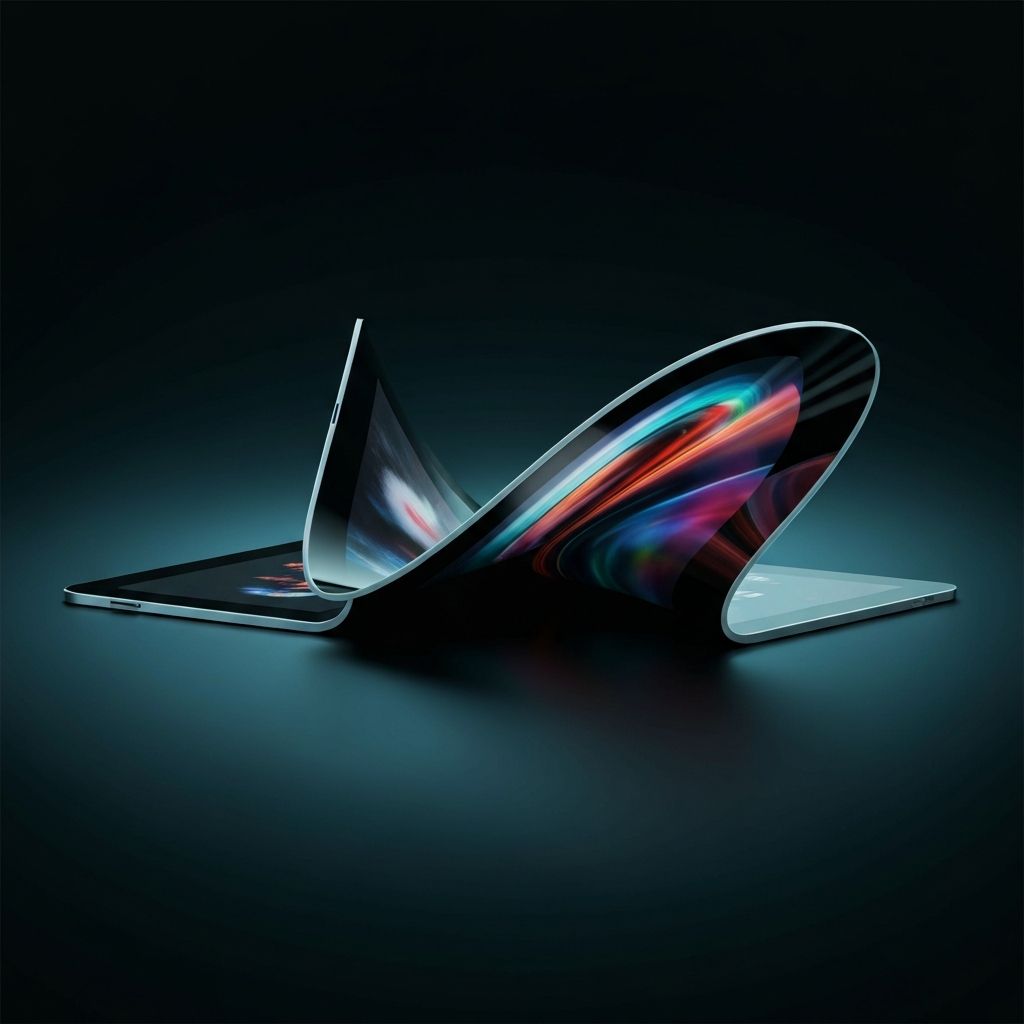
G Display has unveiled what the company claims is the world's first commercial-grade stretchable screen capable of expanding to 50% of its original surface area without any measurable drop in pixel density or colour accuracy. The 12-inch prototype, demonstrated at a closed press event in Seoul, uses a micro-LED architecture bonded to a silicone substrate that stretches uniformly in both axes.
Solving the Interconnect Problem
The engineering challenge with stretchable displays has historically been the interconnect problem: how do you route electrical signals through a surface that is constantly deforming? LG Display's solution uses serpentine copper traces — essentially S-shaped wiring paths that can absorb deformation without fracturing — alongside a self-healing dielectric layer that closes micro-cracks autonomously.
The Applications LG Envisions
The applications the company envisions are deliberately broad. In the automotive sector, stretchable displays could conform to dashboard surfaces of any geometry, eliminating the flat-panel aesthetic that constrains current in-car displays. In wearables, a display that stretches with the skin could enable health monitoring interfaces that sit flush against the body without restriction.
“Not a device that folds — one that reshapes. That is a fundamentally different form-factor paradigm.”
— Yuki Tanaka, EvoFutura
LG Display has not announced a commercial production timeline. However, several tier-one automotive OEMs are reported to be in active evaluation discussions, and the announcement puts LG Display back at the frontier of display innovation following a period in which Samsung Display's foldable technology dominated headlines.